 @ericyocam
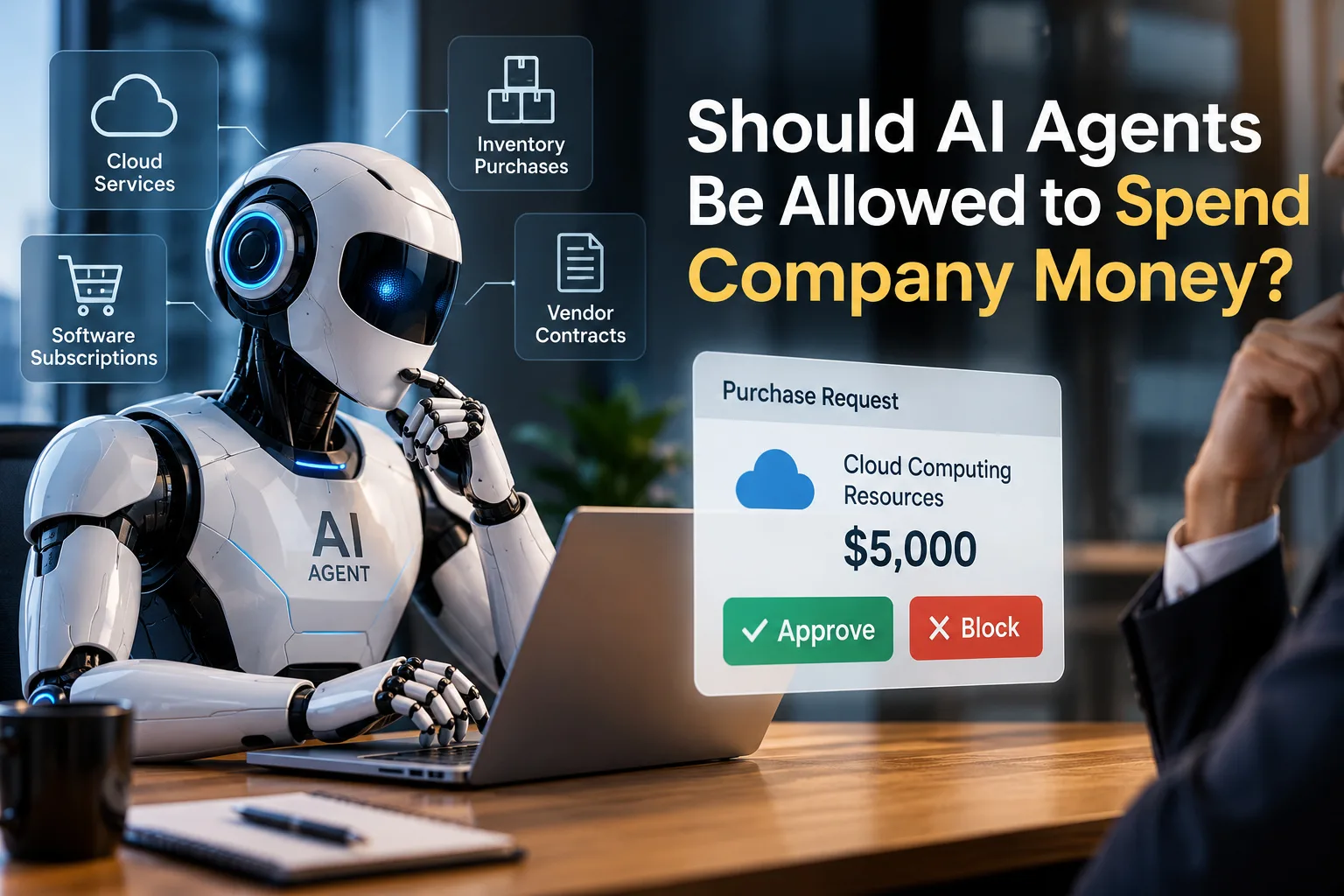
Should AI Agents Be Allowed to Spend Company Money Without Human Approval?
As agentic AI becomes more integrated into business operations, we're moving toward a world where autonomous agents can do more than recommend decisions—they can execute them.
Imagine an AI agent managing cloud infrastructure costs, purchasing software subscriptions, negotiating vendor contracts, or ordering inventory.
The technology creates opportunities for operational efficiency, but it also raises an important business and cybersecurity question:
How much financial authority should organizations delegate to AI agents?
Consider the potential risks:
Unauthorized transactions: An agent makes purchases outside its approved authority.
Financial exposure: An agent commits significant funds because of incorrect information or flawed reasoning.
Cybersecurity threats: Attackers manipulate agents through prompt injection or compromised external systems.
Accountability: Who is responsible when an autonomous transaction causes financial losses?
Governance: How should organizations enforce spending limits, approval requirements, and audit trails?
Traditional financial controls rely on authorization limits, separation of duties, and oversight. Agentic AI introduces a new challenge: autonomous systems that may execute hundreds of transactions without direct human involvement.
My question for the Lounge.ai community:
Should businesses allow AI agents to independently execute financial transactions within predefined spending limits, or should human approval remain mandatory regardless of the amount?
And would your answer change if the agent demonstrated a strong security and reliability track record?
I'd be interested in hearing from founders, CEOs, CFOs, and developers building enterprise AI systems.











3 answers
Good question. I think AI agents should be treated like a new employee: small, low-risk purchases within clear limits can be automated, but anything large, unusual or hard to reverse should still need a human to approve it. Every action should be logged so someone can check it later. A good track record can raise the limits over time, but human oversight should stay.
We developed a price elasticity solution for a large consumer goods company. Initially, the CEO requested that we build a fully automated system. The AI would determine price opportunities based on the channel, SKU, and point of sale, and adjust prices at the point of sale and in SAP, taking into account business rules such as inventory, demand, competency, and protection sales volume. We demonstrated a 10% margin increase, but commercial areas were still pushing back to control the process. Currently, we have agreed with our customer to introduce a human element into the business process. Humans will need to confirm, accept, or reject AI suggestions and become responsible for the business results. I believe that at the beginning of this new era, it is the best approach to take. Build your product to be 100% autonomous, but include the flexibility of the human element in the middle. That is my recommendation.
I would not do anything without human hands, human eyes, and a human brain involved in the process.