The Sequence Radar - Issue #953: Last Week in AI: The Future Has Payment Terms
Next Week in The Sequence:
We continue our series about recursive self-improvement.
We dive into Meta’s new models , Jev’s new version and Liquid’s new Jev competitor.
In the opinion section, we dive into the topic of environments for post-training.
We discuss another amazing robotics project.
Subscribe and don’t miss out:
TheSequence is a reader-supported publication. To receive new posts and support my work, consider becoming a free or paid subscriber.
TheSequence is a reader-supported publication. To receive new posts and support my work, consider becoming a free or paid subscriber.
📝 Editorial: Last Week in AI: The Future Has Payment Terms
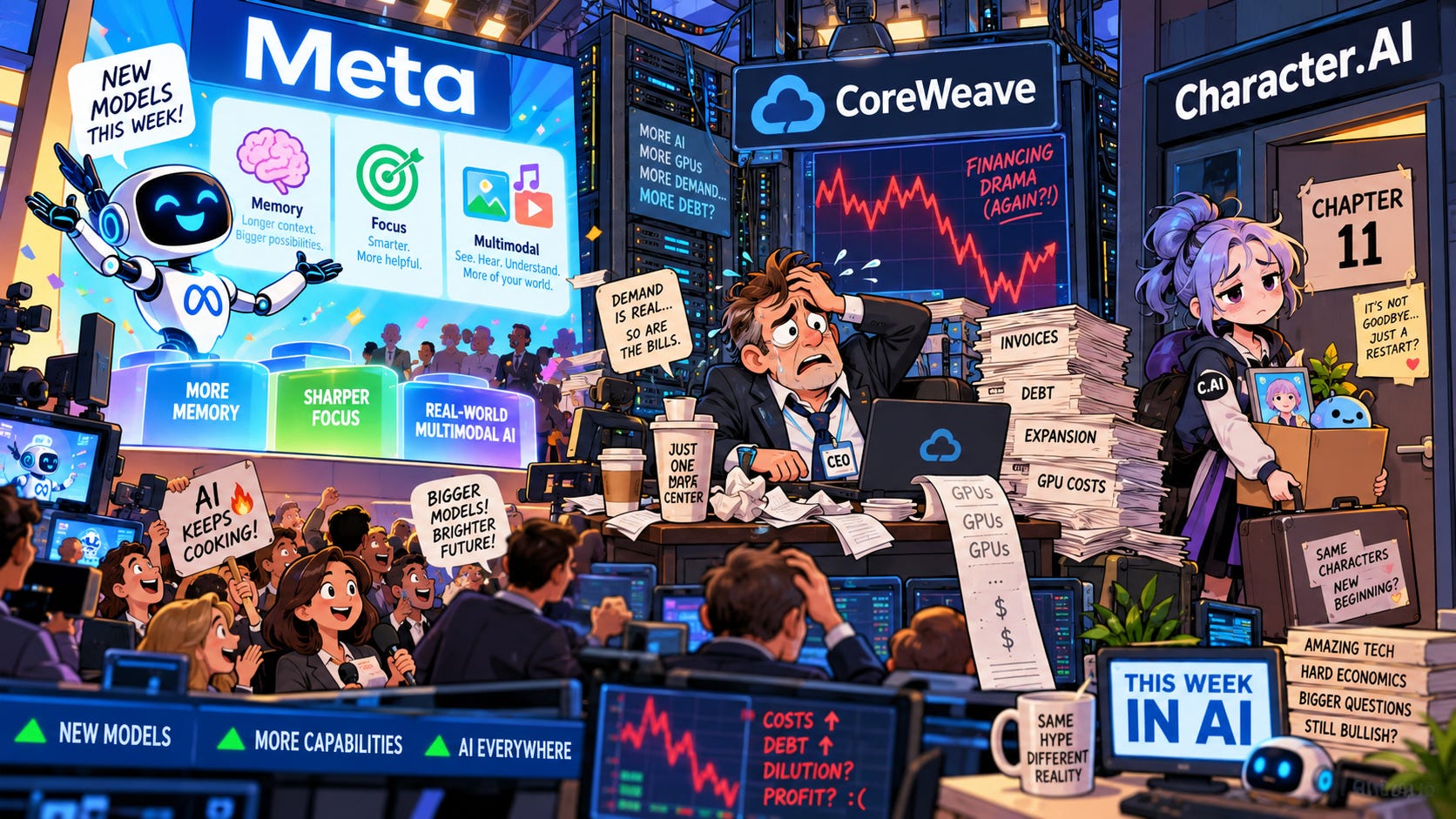
An AI model can be several businesses at once. To a developer, it is something to build with. To a cloud provider, it is a customer for expensive computers. To a user, it might be a helpful colleague or an entertaining companion. These are all plausible sources of value. The question is where the money goes.
Meta is trying several answers. This week it released Muse Wonder and Muse Wonder Full for agentic tasks, with features it calls Active Memory and Active Focus: remembering relevant information, persisting through tasks, and recovering from errors. It also released Muse Spark Open, an open-weight multimodal model with 816 billion parameters, 42 billion active per token.
The strategy looks coherent: sell premium capabilities while letting developers build around another model under Meta’s license. Broader adoption could make the ecosystem more valuable. Giving people access to your technology can be generous and commercially useful at the same time. Capitalism permits this, despite occasional confusion on social media.
CoreWeave has a more immediate question: how to pay for all the computers.
Its shares and bonds sold off as investors worried about the financing behind AI infrastructure. The company reported roughly $104 billion in revenue backlog at June’s end, alongside $640 million of second-quarter net interest expense. The backlog depends on meeting delivery and service-availability requirements.
There is plenty of prospective business. There is also a substantial amount of spending required to turn that business into revenue. A signed lease is valuable, but the tenant generally expects you to produce a building. Bondholders have similarly conventional preferences about receiving their payments.
The relevant question is whether the cash arrives in the right order. Being correct about demand does not automatically make every financing structure sensible. A useful reminder that a company can own a piece of the future and still owe money on Thursday.
Character.AI illustrates the problem from the other end. It filed for Chapter 11 while continuing to operate during a sale process. Reuters reports about 12 million users and monthly operating losses of $8–9 million. Engagement can be wonderful for the retention chart and terrible for the economics.
The company also faces regulatory scrutiny and lawsuits alleging its chatbots encouraged children to harm themselves. The human stakes are serious. Safeguards need to be built into both the product and its operating budget.
Disney’s proposed opening bid offers $20 million plus transition support for specified assets, including a perpetual, nonexclusive license to certain intellectual property, subject to better offers. Technology can retain value even when the company operating it struggles to survive. Those are different things to buy.
My reading is that these stories fit together quite comfortably. Models improve. Developers gain options. Infrastructure attracts customers. Consumer products attract users. Somewhere along that chain, revenues still need to exceed costs, with enough left over to compensate whoever supplied the capital.
The technology does not need to disappoint for some investors to be disappointed. It only needs to distribute the profits differently from the pitch deck.
🔎 AI Research
Harness^2: Recursive Agent Harnessing for an Open World
AI Lab: Google
Summary: Harness^2 is a plug-and-play framework that applies recursive self-improvement to agent execution harnesses in open-world settings with no ground-truth verifiers. Task-level recursion refines the current harness with a contrastive Propose-Probe-Compose step, and harnessing-level recursion distills those edits into a continual-improvement harness for future tasks. A single step lifts GLM-5 and Gemini 3.5 Flash by up to 11.5 points on WorkBuddy-Bench, 4.5 on JobBench, and 11.8 on LAB.
Last Secure Code Benchmark: Is the Code You Vibe Secure?
AI Lab: Alibaba (Qwen Team, Alibaba Cloud) and National University of Singapore
Summary: This benchmark tests whether coding agents write secure code when asked only for functionality. It has 450 tasks built from 150 real vulnerabilities across seven languages and 24 CWEs, in three vibe-coding settings from filling in a function to building a repository from scratch. Six frontier agents pass 73.6% to 91.3% of tasks functionally, yet even the best produces code that is both functional and secure on only 25.1%.
Cortex: Measurement-Gated Evolution and Pruning of Coding-Agent Skills and Rules
AI Lab: Independent (Cortex / Claude Code harness tooling)
Summary: Cortex treats a coding agent’s skills and rules as something to measure, not curate. It harvests replayable tasks from real sessions, proposes one new skill or rule at a time, and keeps it only after multi-run sweeps show a net gain, at least one fire, and no protected-task regression; prune reverses the same test for deletion. Under Claude Haiku 4.5 on a synthetic house-rules lab, evolved harnesses lift held-out rule-family pass rate by +55.0 points versus no skills/rules, add no always-on context, and keep none of 20 placebos or 5 harmful candidates.
ActiveSaddler: Automated Curriculum Learning for Agent Harness Optimization
AI Lab: Microsoft (with POSTECH and KAIST)
Summary: Most harness optimizers fix the training-scenario order and only update how the harness is patched. ActiveSaddler co-evolves the curriculum: it turns recurring failures into failure-pattern arms, scores which to revisit, and balances that against exploring unseen scenarios. On the same AutoSaddler optimizer, it raises test Pass@1 by 4.4 points on GAIA2 and 7.5 on Terminal-Bench 2.0 versus a fixed scenario order, with ablations showing the gains need failure-pattern arms, adaptive prioritization, and adaptive exploration.
MAI-Gym: An Open All-in-One Platform for GUI Agent Evaluation and RL Training across Mobile and Computer Environments
AI Lab: Alibaba (Tongyi-MAI)
Summary: MAI-Gym unifies GUI agent evaluation, data collection, and online reinforcement learning across mobile, computer, and web environments, scaling to 20,000 parallel environments and supporting ten benchmarks. It synthesizes mocked apps and execution-verified tasks, and trains MAI-Gym-9B, which scores 78.4% on MobileWorld and 76.2% on OSWorld-Verified. RL in a mocked train-ticketing app also lifted success on the real app from 28.8% to 48.1%.
3DCodeVerse: Exploring 3D Worlds as Code
AI Lab: USC, University of Rochester, and collaborators
Summary: 3DCodeVerse lets coding agents build editable, verifiable 3D content as executable code, with no diffusion models involved. It combines a 2M-program dataset, a multi-agent harness that checks execution, spatial measurements, and visual feedback, and empirical guidance on 3D coding. Fine-tuning on the dataset improves open models, and the harness wins 90% of pairwise human comparisons against Claude Design (3D Object) when both run on Claude Opus 5.5.
🤖 AI Tech Releases
Muse Wonder
Meta released Muse Wonder and Muse Wonder Full, its most capable models yet, built for personal and professional agents, coding, long-running tasks, and computer use. Trained at Meta’s gigawatt-scale Prometheus data center, both take text, image, video, and audio inputs with a 1M-token context window. Muse Wonder is available through the Meta Model API and Muse Code at $4 per million input tokens and $20 per million output tokens, while Wonder Full is limited to Muse Code subscription plans.
Muse Spark Open
Meta released the weights for Muse Spark Open, a natively multimodal model with 816B total parameters (42B active) and a 1M-token context window, built for coding and agentic work. It runs on two Apple M5 Ultra Mac Studios with MLX and is available through Baseten, Fireworks AI, Groq, Modal, Nebius, OpenRouter, and Together AI, with weights on Hugging Face. It ships under the Muse Model License, which allows free use for many developers with limited commercial terms.
Jev 1.14
TypeSafe AI released Jev 1.14.0 in preview, with small improvements across the board and the biggest gains in multilingual support. It also adds opt-in “danger zone” API flags for composable image inputs and longer context, plus a new box output type that returns a single bounding box. jev-latest will point to 1.14.0 in a week, and jev-1.13.0 stays available for now.
d1-ultra
Liquid AI released d1-ultra, a multimodal decision model that reads text, images, or both in one forward pass and returns calibrated probabilities for yes/no, multiple-choice, and scale questions without generating tokens. It outperforms Jev 1.14 across 112 evaluations and leads the Artificial Analysis Decision Index by at least 8 points. It is available on the Liquid API at $0.042 per million input tokens.
📡 10 AI News You Need to Know About
OpenAI Bugging Arrest: The FBI arrested OpenAI engineer Abdulrahman Alfozan, a 35-year-old Saudi national, on Oct. 9 after the company found a hidden, encrypted audio recorder plugged into a TV in an executive conference room, according to the Justice Department. He’s charged with intercepting oral communications and faces up to five years in prison. FBI Director Kash Patel said the aim was to capture sensitive conversations about OpenAI’s superintelligence work. OpenAI fired him and says it found no sign that model weights, source code, or customer data were accessed.
Character.ai Bankruptcy: Character.ai filed for voluntary Chapter 11 in Delaware on Oct. 12 to run a court-supervised sale of substantially all of its assets, citing high development costs alongside legal, regulatory, and litigation headwinds. Disney is the stalking-horse bidder, offering $20M for a non-exclusive perpetual license to some of Character.ai’s IP plus transition services from former staff it has hired. The platform stays live during the sale, which is expected to close in late November or early December, and it will be wound down if no buyer emerges to keep it running.
Modal Series D: Modal raised a $750M Series D at a $15.75B post-money valuation, led by Accel with Kleiner Perkins joining and all existing investors participating, and said it has crossed $1B in annualized run rate after usage tripled in the five months since its Series C.
Prime Intellect Buys Moondream: Prime Intellect acquired Moondream for undisclosed terms, bringing founders Vik Korrapati and Jay Allen in to lead inference and multimodal work and folding Moondream’s Photon inference engine into its stack, with Moondream 3.1 already served through Prime Inference.
Albert Series B: Albert raised $55 million in a Series B led by TCV, with Coatue, J.P. Morgan Growth Equity Partners, Index Ventures, and Applied Ventures returning, to expand its chemistry-native AI operating system for product R&D.
Pluto Security: Pluto Security came out of stealth with $42 million in total funding, including a $34 million Series A led by Jump Capital, to give security teams visibility and control over the agents and apps employees build with AI tools.
Cohere to Acquire AISLE: Cohere signed a letter of intent to acquire AISLE, a European startup whose autonomous systems find and help remediate previously unknown vulnerabilities in production software (more than 500 CVE-assigned findings in its first year, including all 12 in OpenSSL’s January release). The deal extends Cohere’s sovereign AI push in Europe after Reliant AI and Aleph Alpha, folding security research into its frontier-model and secure-deployment stack.
Ramp $60B Valuation: Ramp raised a $1.85B primary round at a $60B valuation, just four months after its $44B round, led by Dragoneer and co-led by Thrive Capital, Founders Fund, Sands Capital, and Avenir Growth. The company says annualized revenue now tops $2B with positive cash flow, and it counts more than 85,000 customers and over $275B in annualized purchase volume. Ramp has been pushing deeper into AI with agent-ready corporate cards, a model routing service, and Glass, a shared workspace for employees’ AI automations and skills.
CoreWeave Debt Scare: CoreWeave shares fell about 15.5% on Oct. 14 and yields on its 2032 bonds hit roughly 15% as investors questioned how the neocloud funds its AI data-center build-out. CEO Mike Intrator told staff in a memo, reported by Reuters, that its backlog, last reported at $104.2B, more than covers its debt, which is about $50B. Credit-default insurance has climbed to around 1,000 basis points, implying a roughly 63% five-year default chance, up from about 30% a year ago.
Anthropic Q3 Revenue: Bloomberg reported that Anthropic told prospective IPO investors its third-quarter revenue reached $16.8B, up 45% from $11.6B in Q2, and that it was profitable on an adjusted basis. Growth slowed sharply from the more than 140% jump between Q1 and Q2, and some investors are now discussing a valuation nearer $1.5T than the roughly $2T once expected. IFR reports Anthropic plans to make its SEC filing public on Oct. 26 and list in mid-November, though the company hasn’t confirmed the figures or dates.