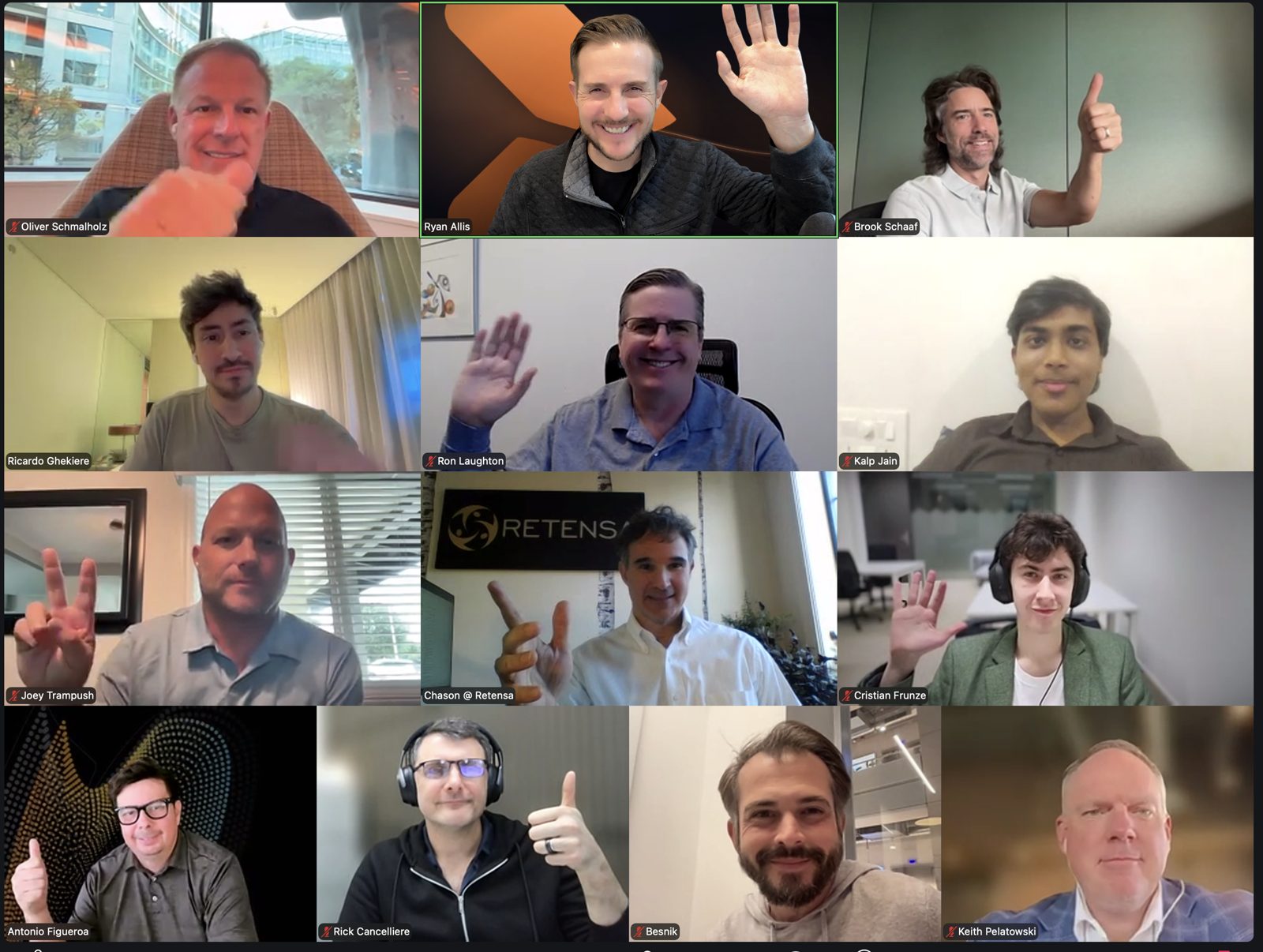
Weekly AI Founder Mastermind recap, October 29: 18 founders on the call
The fourth Weekly AI Founder Mastermind, and the first at 60 minutes, brought together 18 founders calling in from New York, Lisbon, London, Amsterdam, India, Minneapolis, Pittsburgh, Orlando, Los Angeles, St. Petersburg, South Africa and Austin. Three topics: how to rebuild a 20-year-old SaaS platform to be AI-native in six months, how to let AI answer questions from your own data safely, and what happens to code review and CI once AI is writing hundreds of pull requests a day. The thread through all three: the AI tools work, but the results come from the system you build around them (guardrails, context, review loops and the right people leading it).
- Growth: Lounge just passed 2,500 members, about 230 of them founders at a verified $1M+ ARR. A week ago it was 1,066 and 182.
- City ambassadors: Berlin, Lisbon (Oliver Schmalholz is our Lisbon host), Ankara, Mogadishu, Tokyo, London, Reno and Austin, with new applications from Montreal and Cleveland. The only commitment is one event per quarter. Once sponsors are on board, in the next month or two, each city gets about $1,000 for food and drinks. Want to host, or sponsor an event in your city? Message Ryan.
- Member map: find the members near you on the map (Austin is at 38) and set up a local meetup.
- Format: the room gave a thumbs up to keeping the call at 60 minutes.
Keith Pelatowski (Chief Executive Officer, Points North) brought the main question. Points North is a bootstrapped, profitable company of about 70 people with a deep niche in prevailing wage and certified payroll reporting. Its platform leads the market but is 20 years old, and that stack is now what keeps it from adding AI to its users' workflows. About 15 engineers have used Claude Code for six months; 2 or 3 use it every day and the rest are still adopting it. The goal: rebuild the platform to be AI-native and launch it by April or May. "One of our biggest questions on our engineering team is who is truly ready to cross the bridge from how we used to do things to how we will do things."
- Chason Hecht (Retensa) asked about runway first, because it changes the answer: "I'm shortening my runway, so I'm buying my way to outcomes instead of building my way to outcomes. That's a philosophy I didn't have in 25 years of doing this." With runway, he would build it in-house: "If you value that talent, they will appreciate having done it themselves. My team has real pride of ownership in having converted our workplace, versus a consultant coming in and telling them how." His warning from experience: they first gave the project to the wrong project manager. "Make sure the person who leads this embraces the technology. If there's a hint of resistance, it's the wrong person, and those people are in every workplace." He also shared that about 38% of Gen Z don't believe AI will help their future.
- Ron Laughton (Founder & CEO, ReviewInc) went into beta with his rebuilt portal the night before the call. His three developers, on $100-a-month Claude Code plans, upgraded a 15-year-old codebase from Bootstrap 4 to 5, added Section 508 accessibility (keyboard and voice commands, which matter for government contracts), a search bar across the whole platform, and an AI help assistant that replaces the knowledge base. "The team pulled it off in about three weeks, which stunned me. I was expecting six months." His setup: move every key and secret into Azure Key Vault before Claude touches the code; give Claude a full schema dump but never the database itself (it writes good queries and has suggested several indexes). "Time and time again, when Claude didn't behave the way we thought it should, it was because we didn't write the prompt with enough clarity." His advice for Keith: "Dive into the deep end of the pool and just do it."
- Antonio Figueroa (Founder and CEO, Raken AI Labs) modernizes products version by version instead of a big-bang rewrite. First, reverse-engineer the real business rules, "the ones nobody documented." Then use AI to turn them into a working prototype and iterate with the customer in short cycles, while the engineering team builds the back end in parallel with Claude skills. Complex supply chain, manufacturing and commercial solutions for large enterprises now ship in 6 to 8 weeks, and Raken's gross margin went from 40% to 67% in six months.
- Brook Schaaf (Co-Founder and CEO, FMTC) rebuilt his stack before AI coding and went through two development leads who loved the idea of a process but didn't follow it: user stories started and never finished, thin testing, and the same pattern when they set up AI code review. "I've become convinced the solution is to dial in the guardrails very carefully. That's where things break now." Codex writes great SQL for his data processing, he said, and the failure point is the tight cycle of re-prompting.
- Besnik Vrellaku (CEO & Founder, Salesflow) faced the same choice with an 8-year-old bootstrapped company: keep migrating legacy code and working down the backlog, or rebuild AI-native from an agentic foundation. He rebuilt everything over 8 months on a new stack, with every engineer learning a new framework, while keeping parts of the existing infrastructure. "Migrating it all, we'd have ended up with a wall of spaghetti. Rebuilding from scratch on our existing infrastructure solved legacy problems we had never managed to fix." His suggestion for Keith: if a full rebuild is too much, try it on one module.
- Rick Cancelliere (Founder and CEO, PracticeBeat) tied the rebuild to a business problem, because "engineers really like to solve problems." Implementations took 60 to 90 days and cost about $25,000 a month per project in delayed revenue. The goal became going live in one day, with bonuses tied to the result. He also took the team to San Francisco to see AI-native teams at work and connected them with teams like Ricardo's. "The team is more AI-native now, and they fix legacy code faster as they see the impact of their work."
- Kalp Jain (Developer, Independent): "When you built the codebase, you hired experts. Do the same with AI. Connecting ChatGPT or Codex to your code base will help, but not as much as building a system designed specifically for migrating your code base." In the chat: "The biggest mistake founders make when migrating legacy codebases is thinking that any AI tool will help them."
- Cristian Frunze (Founder, Ken) had a tip for Keith's engineers in the chat: try Claude Code's Ultracode mode for rewriting an entire module. "Just try it once, then they'll be addicted." (More on how he uses it below.)
Lessons learned on rebuilding legacy SaaS
- Tie the rebuild to a business problem with a number on it (implementation time, revenue leakage, gross margin) and to the team's bonuses.
- Build it in-house if you have runway, and choose the project lead carefully. Pride of ownership keeps your best engineers; a reluctant lead stalls the whole thing.
- Write down the undocumented business rules first, then rebuild version by version in short prototype cycles, not one big-bang rewrite.
- Secure it before you start: secrets out of the code, a schema for Claude instead of database access.
- The guardrails are the work. Unclear prompts and half-finished processes cause more failures than the models do.
- Rebuild from scratch where the old code would only add spaghetti, and keep the infrastructure that still works.
Ron Laughton has more than 100 reports in ReviewInc and wants customers to just ask, for example, "Which reviews from the last month should I respond to?" His question: what is the best way to give AI the data it needs: MCP with a temporary token, or server-to-server?
- Antonio Figueroa built this a year ago for a large telecom with a petabyte data lake, mostly on Snowflake. They tried Bedrock, Snowflake Intelligence and Copilot, and every approach had the same problem: answer quality and hallucinations. What fixed it was a strong metadata layer: the meaning of every KPI and dimension, where the data lives, how the tables are structured and what questions users will ask. Today tools do much of it for you. Qlik Answers runs on Anthropic behind the scenes, and Starburst uses AI to build the metadata layer and gets you "60 to 70% of the way there." Qlik and Snowflake both have MCP servers. "MCPs already exist. You still need to build the business knowledge, the context and the rules, so the agent goes exactly where it needs to instead of through the whole database."
- Ricardo Ghekiere (Founder, Patricia.app) said Patricia doesn't import a customer's whole Google Drive. It maps where the data is so the model knows where to fetch it. His CTO's rule: "If it feels like magic, it's prompted magic. Somewhere an engineer spent the time to figure out what the prompt should look like." Every Monday they get a report of every prompt that went wrong; AI fixes each one and tells the customer it's fixed. "Out of the box these models are actually quite stupid. You need to give them context and skills, and have an engineer looking at whether the output is good." Some use cases take 50 rounds to get right.
- Ron's takeaway: he'll likely build an MCP layer, because the AI can't have free rein on the database. Every answer has to be filtered to that user's access level, and with medical clients, PHI and PII have to be sanitized before the AI ever sees them.
Lessons learned on AI and your data
- Build the metadata layer first: what every metric means, where it lives and what people will ask. That business knowledge is what makes answers accurate.
- MCP is the connector, not the solution. The context and rules you put behind it decide the quality.
- Filter by permission and sanitize sensitive data before the model touches it.
- Track the prompts that fail and fix them every week. Plan for dozens of rounds per use case.
- Ricardo Ghekiere used CodeRabbit until about six months ago. "It kept breaking. We were on the highest plan and they didn't have a higher one for us." They built their own internal review tool. The merge queue was the next bottleneck: everyone was shipping PRs at once, so they now batch PRs into "trains" that go to production together. Review tools and GitHub had cost about $4,000 a month; now it's about $1,000 to $1,500. "For the age of AI, there are tools that still have to be invented."
- Cristian Frunze is #4 of 2,500 members on Lounge's GitHub leaderboard, with 44,425 contributions in the last 12 months. His team was paying about $1,000 a month for a hosted CI provider plus a paid review tool, so they moved CI/CD onto their own dedicated bare-metal servers. One server runs Claude Code, Grok and Codex accounts used only for code review. A classifier in the pipeline routes each PR by size: an open-source model or Grok for light changes, Opus for medium, and OpenAI's top models plus Opus for the heaviest. Reviews run in a loop of 3 to 5 rounds. It took about two days of engineering. "If you ship more than 50 PRs a day, no code review tool will keep up, and the price is crazy. I wouldn't pay for a review tool again."
- Ken's numbers. Cristian shared Ken's internal dashboard. Over the last 30 days, his team of two (Cristian and Cristian Prodius, CTO, Ken) merged 4,666 pull requests (4,390 of them Cristian's), made 11,439 commits, changed about 14 million lines in merged PRs and closed 4,396 Linear issues. They used 371 billion Claude Code tokens, about $172,600 at API list prices, paid for with $3 million in Anthropic credits from their accelerator that arrived October 5. You can see the date on the chart: a few dozen merged PRs a day before it, and 250 to 350 a day by late October. The last seven days alone: about 1,700 PRs, 3.6 million lines and $45,000 of Claude Code at API prices. On subscriptions, Cristian estimated the same usage would cost about $3,000. Chason asked the useful benchmark question: what is your cost per commit? At API prices, Ken's works out to about $15.
- Ultracode mode. Cristian plans an entire project in Linear and gives Claude the link with Ultracode mode on. Claude asks a few questions, then spins up 10, 20 or 50 sub-agents at once. "When you have an entire module, it gets through it really fast. By fast I mean six hours, so I let it run overnight." It handles rate limits on its own, runs review loops, and opens stacked PRs. He finds Opus 5.5 very reliable for this, especially with a ChatGPT model reviewing.
Lessons learned on CI/CD with AI
- Past about 50 PRs a day, off-the-shelf review tools break. Plan for your own review pipeline.
- Route reviews by size and risk: cheap models for small changes, the strongest models for the big ones, and loop until they pass.
- Batch merges into trains so the merge queue doesn't jam.
- Measure output and cost per person per day. Know your cost per commit.
- For a whole module, plan the work as tickets first, then let parallel sub-agents run overnight.
Andrei Stefan (CEO, Vitals), Richard Turner (President & Founder, Convergence Data), Joey Trampush (Founder & Chief Neuropsychologist, brainworkup), and from the SaasRise team David Trachsel and Lee Radloff.
- Thursday, November 5 at 11 AM CT, 60 minutes on Zoom. Join for part of it if that's all you can make.
- Bring a topic: add it on the mastermind page and vote on what we cover. Ideas from today: monetizing AI inside your app, and what happens to AI pricing as teams move to open-weight and self-hosted models.
The Weekly AI Founder Mastermind is for Lounge Pro members and for founders with $1M+ ARR that we can verify through Apollo or Moltsets. If you got value from this recap, the live call is where you can bring your own problem to the room.











- Andrei Stefan · CEO, Vitals
- Antonio Figueroa · Founder and CEO, Raken AI Labs
- Besnik Vrellaku · CEO & Founder, Salesflow
- Brook Schaaf · Co-Founder and CEO, FMTC
- Chason Hecht · CEO, Retensa Employee Retention
- Cristian Frunze · Founder, Ken
- David Trachsel · Head of Growth, SaasRise
- Joey Trampush · Founder & Chief Neuropsychologist, brainworkup
- Kalp Jain · Developer, Independent
- Keith Pelatowski · Chief Executive Officer, Points North
- Lee Radloff · Head of Sales & Member Success, SaasRise
- Oliver Schmalholz · Chief AI Builder & Co-Founder, ListKit
- Ricardo Ghekiere · Founder, Patricia.app
- Richard Turner · President & Founder, Convergence Data
- Rick Cancelliere · Founder and CEO, PracticeBeat
- Ron Datraxman Carter · founder ceo /soverign architect builder/developer, FUNKHOPINCCRYPTO-ENT-LLC SJPUBLISHINGTRACKER DATA VAULT
- Ron Laughton · Founder & CEO, ReviewInc
- Ryan Allis · CEO, Lounge.ai & SaasRise












Comments
0 comments